
Pakistan's security forces, law-enforcement agencies and intelligence agencies conducted more than 40,000 intelligence-based operations (IBOs) across the country during the first seven months of 2026, while 2,084 terrorists were killed, according to the latest counter-terrorism figures shared by Director General Inter-Services Public Relations (DG ISPR).
As of the end of July, a total of 40,348 IBOs had been conducted across Pakistan, averaging approximately 190 operations per day. Of these, 31,080 were carried out in Balochistan, 7,177 in Khyber Pakhtunkhwa (KP), and 2,091 in the rest of the country.
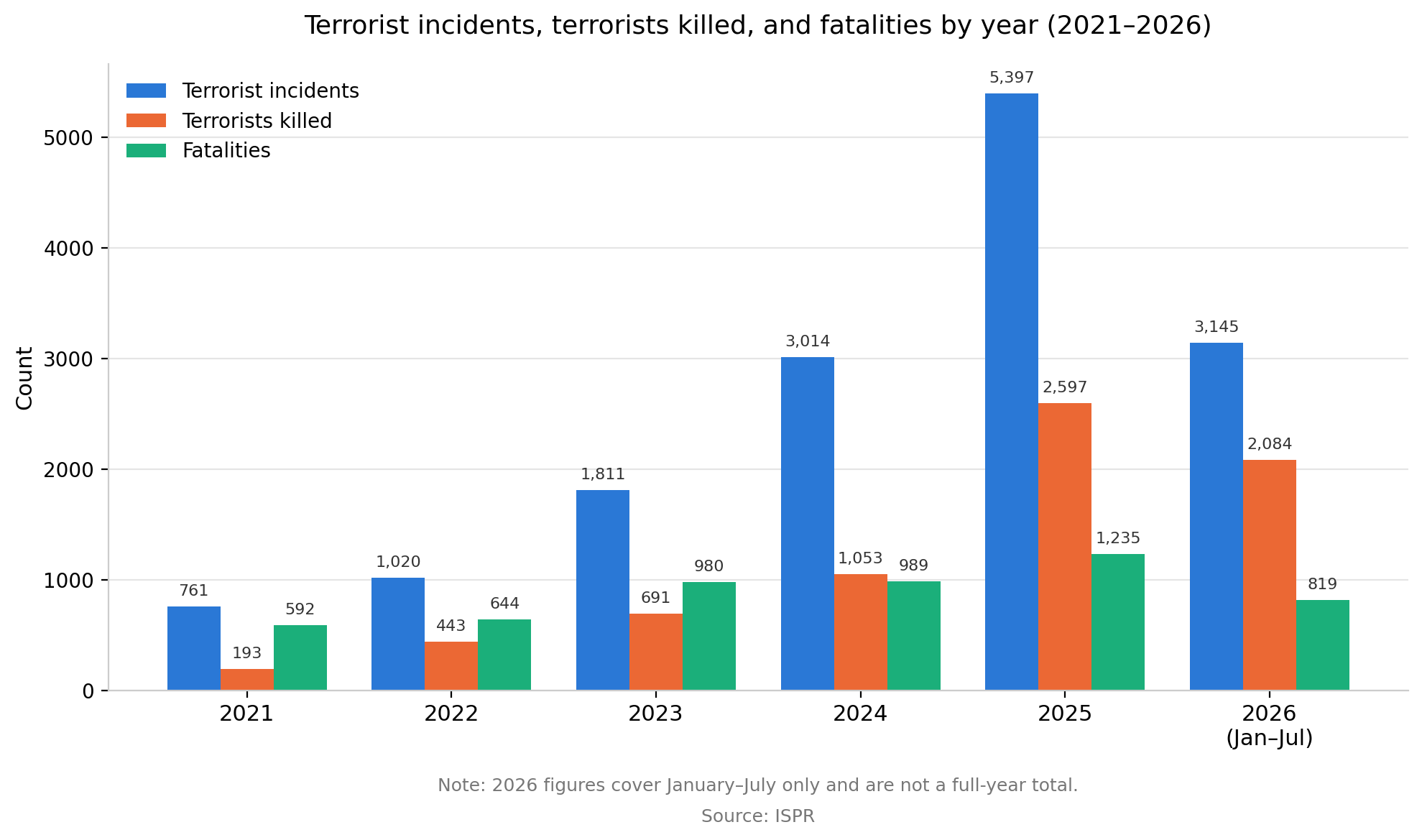
The scale of intelligence-led operations coincided with a sharp increase in the number of terrorists killed. Security forces reported 2,084 terrorists killed between January and July 2026, compared with 2,597 during the whole of 2025, 1,053 in 2024, 691 in 2023, 443 in 2022 and 193 in 2021.
The 2026 figure has already reached around 80 percent of the full-year 2025 total and is nearly double the number recorded during all of 2024. On average, approximately 10 terrorists were killed every day during the first seven months of 2026, representing the highest daily rate of terrorist neutralization in the five-year comparison.
819 fatalities recorded among security personnel and civilians
The counter-terrorism campaign also resulted in significant losses among security personnel and civilians. A total of 819 fatalities were recorded during January–July 2026, comprising 303 armed forces personnel, 194 law-enforcement personnel and 322 civilians.
The figure remains below the full-year totals recorded in previous years. Pakistan recorded 1,235 fatalities in 2025, 989 in 2024, 980 in 2023, 644 in 2022 and 592 in 2021.
The lower seven-month figure in 2026 comes despite the substantially higher level of counter-terrorism activity and the continued high number of terrorist incidents across the country.
3,145 terrorist incidents reported
Pakistan recorded 3,145 terrorist incidents during January–July 2026, according to the reported figures. The seven-month total has already surpassed the 3,014 incidents recorded during the entire year of 2024 and represents approximately 58 percent of the 5,397 incidents reported in 2025.
The number of incidents remained heavily concentrated in KP and Balochistan. Khyber Pakhtunkhwa recorded 1,971 incidents, while Balochistan recorded 1,148. A further 26 incidents were reported in the rest of Pakistan.
Together, KP and Balochistan accounted for 3,119 of the 3,145 terrorist incidents, underlining the continued concentration of Pakistan's terrorism challenge in the country's western provinces.
28 suicide attacks and cross-border concerns
The period also witnessed 28 suicide bombings. According to the reported security assessment, Afghan nationals constituted the majority of suicide attackers, highlighting the continuing cross-border dimension of Pakistan's terrorism threat.
Suicide attacks were reported in locations including Tank and Karachi, indicating that militant violence remained capable of reaching both border districts and major urban centres.
Five-year comparison
Increased operational intensity
The latest figures indicate a significant increase in Pakistan's counter-terrorism operational intensity during 2026. While terrorist incidents remain elevated, the number of terrorists killed has risen substantially compared with previous years, alongside a sharp increase in intelligence-based operations.
The 40,348 IBOs conducted during the first seven months indicate a sustained intelligence-led effort to identify, target, and disrupt militant networks. The overwhelming concentration of operations in Balochistan and KP broadly corresponds with the geographic distribution of terrorist incidents.
Overall, the July 2026 figures indicate a high-intensity but still inconclusive counter-terrorism environment in Pakistan. While operations have expanded significantly and produced substantial militant casualties, the continued occurrence of 3,145 terrorist incidents shows that militant groups remain active and capable of sustained disruption. The data therefore reflects a situation where security forces are applying strong and widespread pressure, but this has not yet translated into a decisive reduction in the overall threat level, with both sides continuing to operate at scale.