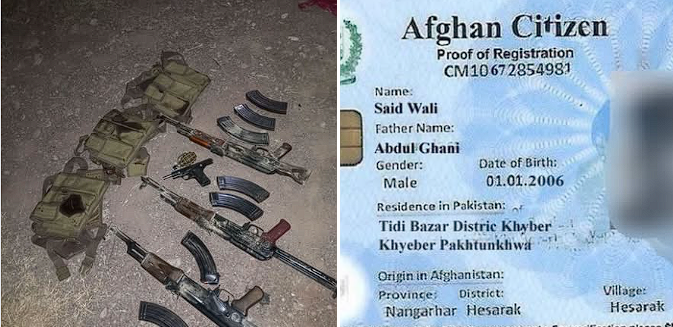

The Afghan Taliban continue to demand "concrete evidence" that terrorist groups operate from Afghan soil. Meanwhile, 25 terrorists were recently killed in a single infiltration attempt along the Pakistan-Afghanistan border. Among them were Afghan nationals. This is not an isolated claim from one country. It is a pattern repeating across four countries.
Pakistan is bearing the brunt of it. The Global Terrorism Index 2026 recorded 1,139 terrorism-related deaths in Pakistan in 2025. It also recorded 1,045 attacks. This makes Pakistan the world's most terrorism-affected country. It is also the country's deadliest year since 2013. The report explicitly ties this deterioration to the Taliban's return to power. It points to the resulting cross-border militancy. Groups based in Afghanistan have intensified attacks along the Pakistan-Afghanistan border.
But the threat is not confined to Pakistan. That is precisely the point. Tajikistan has faced repeated, deadly attacks launched from Afghan territory. On November 26, 2025, a drone attack hit a Chinese-run gold-mining compound in Tajikistan's Khatlon region, killing three Chinese nationals. Four days later, on November 30, gunmen killed two more Chinese workers at a Chinese state-owned company site in Tajikistan's Darvoz district. On December 24, 2025, a separate cross-border clash killed two Tajik border guards. The Collective Security Treaty Organization has since stepped in, approving a five-year program to reinforce the Tajik-Afghan border. Russia, Belarus, and Kazakhstan are supplying weapons and equipment, with the first deliveries scheduled for autumn 2026.
China and Iran have independently reported the same pattern. China's mission to the UN Security Council urged the Taliban to take "resolute action." It named groups including ETIM, the East Turkestan Islamic Movement, still operating from Afghan territory. Iranian authorities have similarly blamed Afghanistan-based militants for high-profile terrorist attacks inside Iran.
Pakistan, Tajikistan, China, and Iran did not coordinate a shared narrative. Each faced the same threat. Each faced it from the same territory. Each arrived at the same conclusion independently, through its own intelligence assessments, its own border casualties, and its own diplomatic statements. That convergence exposes the Taliban's position for what it is. Cross-border terrorism from Afghanistan is not propaganda. It is not invention. It is not exaggeration. It is a documented, region-wide reality. Nearly five years into Taliban rule, this is not a question of capacity. The selective tolerance shown to groups like the TTP, Al Qaeda, BLA, and ETIM points to a deliberate policy choice. It is not an inability to act. Kabul is not failing to stop these groups. It is choosing not to.